

Black Hat is two months away. By now, most cybersecurity startups have already booked their booth space, started stressing about swag, and received at least three emails offering to sell them an attendee list. (Don’t buy it.)
On June 3, the Blue Seedling team sat down with a (virtual) room full of cybersecurity marketers and founders to share everything they have learned from running Black Hat campaigns for some of the fastest-growing cybersecurity companies. Here are the top takeaways.
Watch the recording
The full session, including Q&A, is available below. You can also find the deck here.
Essential Takeaways to Win at Black Hat
The goal conversation you need to have before you spend a dollar
Ask ten people at your company why they are going to Black Hat, and you will probably get ten different answers. Pipeline. Brand. Relationships. Investor optics. All of the above.
None of those answers are wrong, but running all of them at once without a clear priority is how you end up spending $400,000 and coming home with nothing to show for it. At Blue Seedling, we see three goals come up again and again: pipeline generation, ecosystem relationships, and brand and category leadership. Same conference, same budget, completely different plan depending on which one is actually driving your decisions.
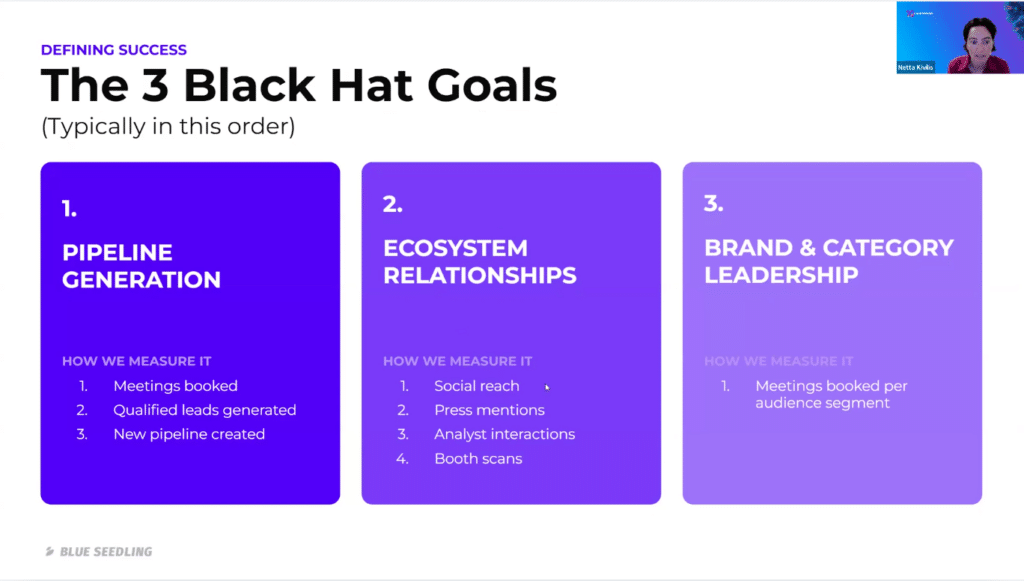

Decide in advance, put it in writing, attach measurable KPIs to each objective, and make sure the CEO, CFO, and CRO are all aligned before anyone books a flight. Do this before you do anything else.
Your booth has five seconds
Over 400 companies will be on the floor at Mandalay Bay. A person walking the expo hall is making split-second decisions about where to stop and where to keep moving. You have roughly five seconds to communicate what you do and why they should care.
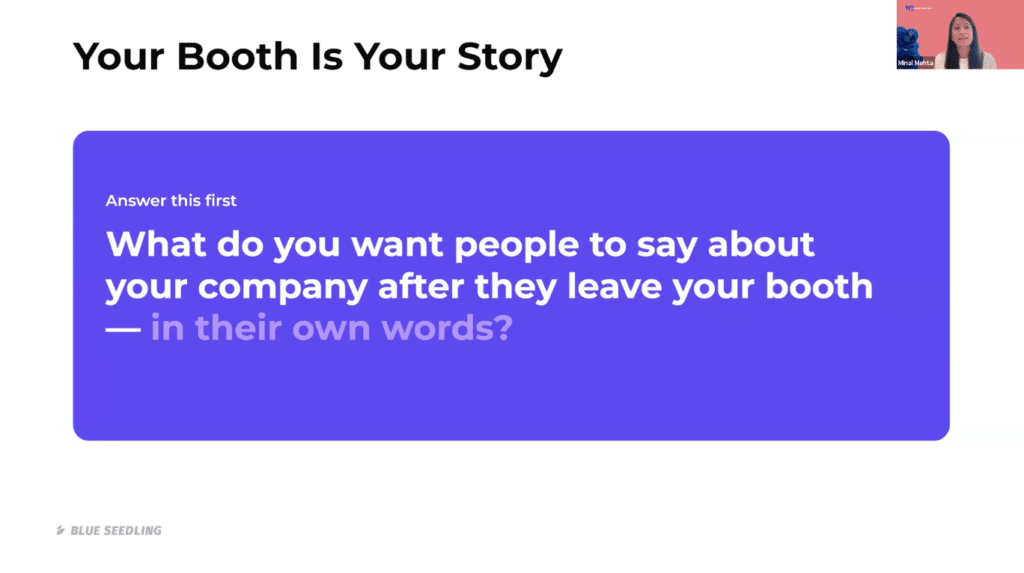
Most booths fail this test because they are built backwards. The team starts with what they want to show, ends up with a product demo and a logo wall, and calls it a day. The better question to start with is: what do you want someone to say about your company after they walk away, in their own words?
Write that down. Then ask five people on your team to write their answers down separately. If the answers do not match, you have a problem that no amount of swag is going to fix.
Before you spend another dollar
Put four things on paper: a one-sentence company description anyone can understand, a written perception statement, a messaging hierarchy with one key message and two supporting lines, and a ten-word booth headline that makes your category obvious to someone with zero context. Get these right and everything else, the design, the swag, the staff pitch follows from there.
What good looks like on the floor
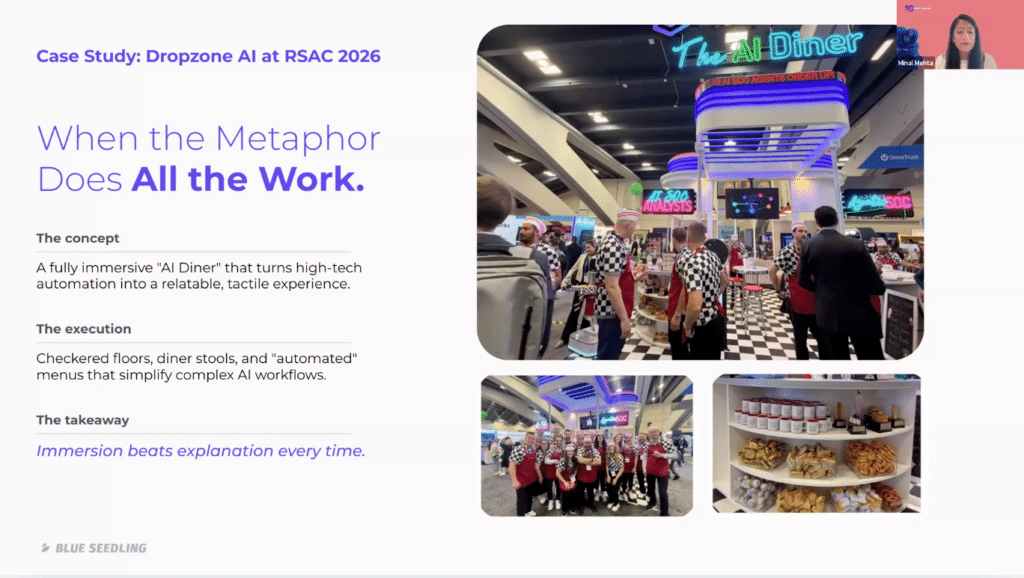
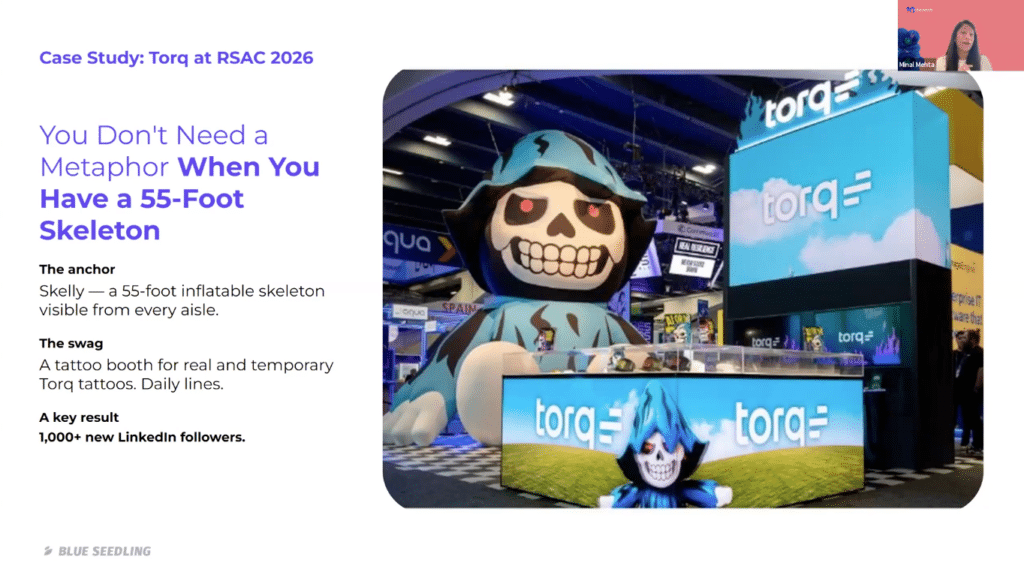
Three booths from RSA 2026 showed what it looks like when you get this right. One built a fully immersive themed experience that drove thousands of badge scans and over 20,000 social impressions. One went the opposite direction: a small booth, no gimmick, just a sharp brand and one crystal clear headline. Another put up a 55-foot inflatable mascot and gained over 1,000 new LinkedIn followers during the show. Three completely different strategies. All worked. Because every single one of them knew exactly what impression they were trying to make.

AI is changing how cybersecurity startups plan for Black Hat
The teams using it well are building faster, deciding faster, and showing up better prepared.
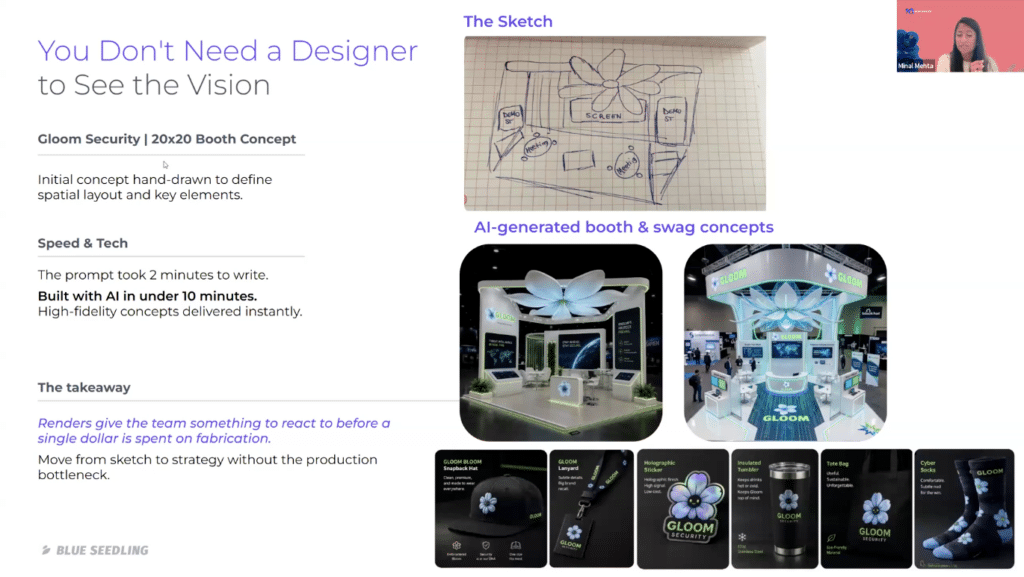
One of the most underrated applications: booth visualization. Write your perception statement, describe your booth in plain English, put it into an AI image generator. Before you spend a dollar on fabrication, you have something your whole team can react to.
AI acts as a mirror for your story. The sharper your narrative, the better the output.
We tested this with a fictional company called Gloom Security. Full booth concept, complete swag range, one sitting. Two minutes.
Pre-booked meetings are where the ROI lives
Here is the uncomfortable truth. Everything visible at Black Hat, the booth, the parties, the swag, accounts for maybe 20% of your ROI. The other 80% comes from what your prospects never see: the meetings you booked before you landed in Vegas.
Building your list
There is no official attendee list distributed before the show. Build yours by pulling speakers and sponsors from the Black Hat website, watching LinkedIn for people announcing they are attending, and reaching out to basically everyone you would want to talk to. Assume they are going. The worst they can say is they are not.
Conducting outreach
Use both email and LinkedIn. In cybersecurity especially, email deliverability is getting harder, but the combination of both channels to the same person still works. LinkedIn is currently dominating in cyber. Founder and CEO outreach consistently outperforms sales rep outreach, so if you can get your executives sending messages, do it. Keep your sending volume in check: around 100 LinkedIn messages per week, 25 cold emails per day. Send in waves, not blasts.
Start earlier than you think
By the time you reach out two weeks before the show, calendars are full. Start six weeks out. And make it easy for people to book: one unified calendar link, no back-and-forth, no three-day scheduling chains.
What good looks like
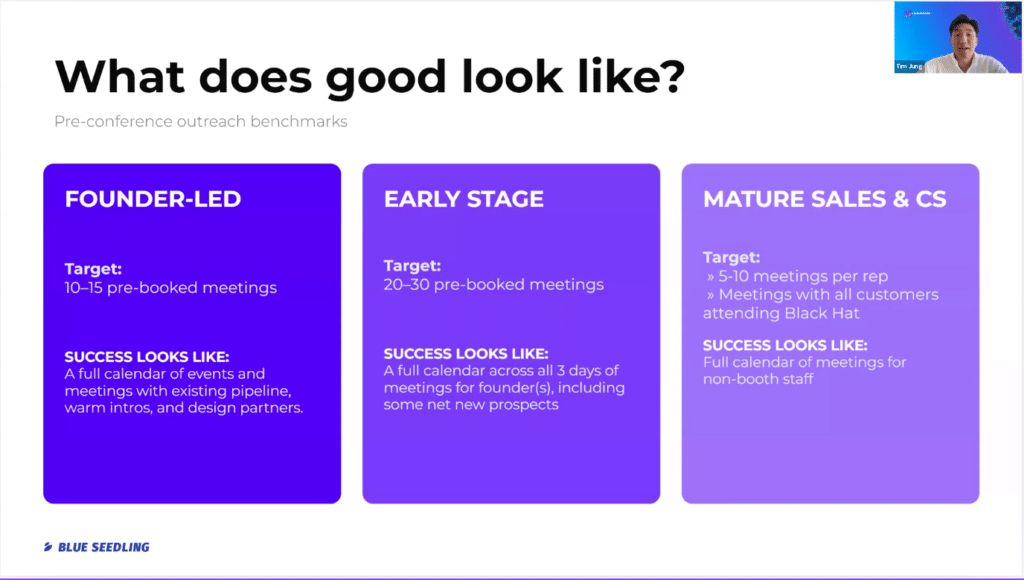
Founder-led companies should aim for 10 to 15 pre-booked meetings. Early-stage startups with a small sales team, 20 to 30. Companies with mature sales and customer success teams, 5 to 10 per rep, plus meetings with every customer attending the show.
Post-show is not the finish line
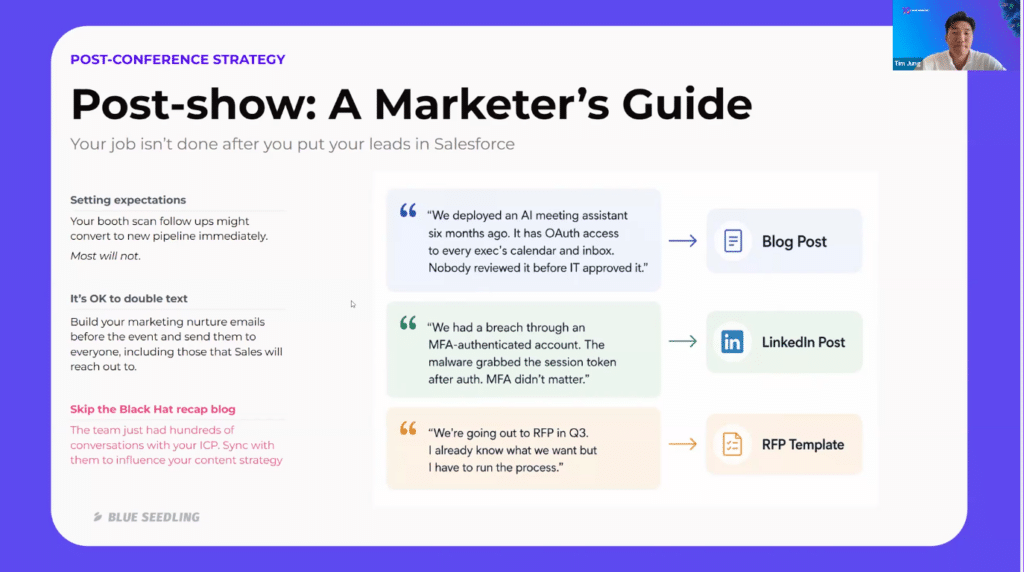
Most booth scans will not convert immediately. That is not a failure. It is just how it works. Treat every scan as an ABM touchpoint and build your nurture plan before you leave for Vegas, not after you get home.
Follow up fast
It is fine to double text. Marketing can send a follow-up sequence to every lead while sales does personal outreach to the priority ones. Both can land in the same inbox. That is a feature, not a bug.
Skip the recap blog
Your team just spent three days having hundreds of conversations with your ICP. That is gold. Schedule a quick debrief, find out what themes kept coming up, what objections surfaced, what problems people kept describing. Let that shape your content strategy for the rest of the year.
Want a plan built for your specific situation? Blue Seedling offers one-on-one Black Hat coaching sessions and full field marketing support before, during, and after the show. Let’s talk.