

In the early days of building your marketing operation, sending an email newsletter to your database may seem like a quick and easy win — and it often is. But the common type of newsletter that many startups send can have real pitfalls. I’m talking about the standard, HTML-heavy, Mailchimp/Hubspot/Marketo template newsletter. I bet you can find one in your inbox right now—or in your spam folder.
After 10 years of building Blue Seedling and working with startups across industries, we’ve seen this pattern play out again and again. Even now, with AI making it easier than ever to generate content, these patterns still hold.
Here are some examples of this garden-variety newsletter template:
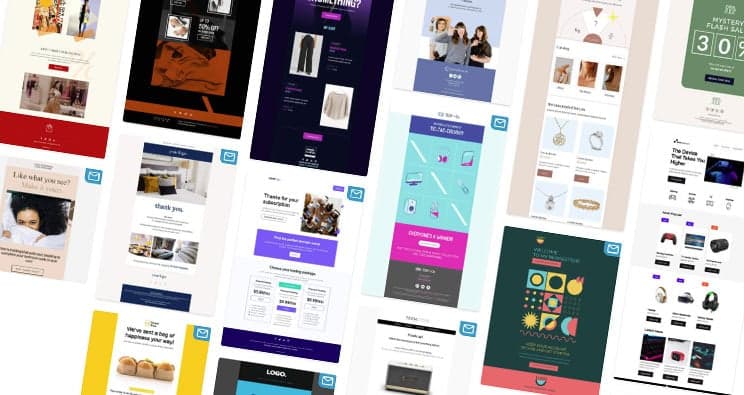
So, what are the pitfalls of sending a newsletter like this?
- This type of newsletter is aesthetically very common, and so unless yours is designed by the da Vinci of HTML, it won’t visually stand out to your audience. So the content better be absolutely mind-blowing and AI content simply won’t cut it.
- Unfortunately, that mind-blowing content will have to fit in a very small amount of real estate. In template newsletters, there is often more space taken up by the design elements — hero images, buttons, borders, and padding — than the actual content.
- Even if the content is compelling, you may get clicks, but you’ll probably never get a reply. This isn’t necessarily the worst thing since newsletters are a “top of funnel” type of marketing. But as an early-stage startup, can you afford to spend time building a marketing channel that is going to initiate zero direct conversations with your target audience? Probably not.
In our experience, there’s one type of newsletter that transcends these pitfalls and stands out from the pack: a simple, mostly plain-text email from a real person, filled with links to valuable content and commentary that will stick with your audience — and even make them enthusiastically reply. In a world of AI-generated content, this kind of human, personal email stands out even more.
At Blue Seedling, we call this type of newsletter The Reader. The Reader isn’t just something for your audience to skim and then archive; The Reader is an email that will actually be worth, well, reading.
It’s also a format we’ve used and refined over the years — and one we still believe in today.
Here’s what a Reader looks like:
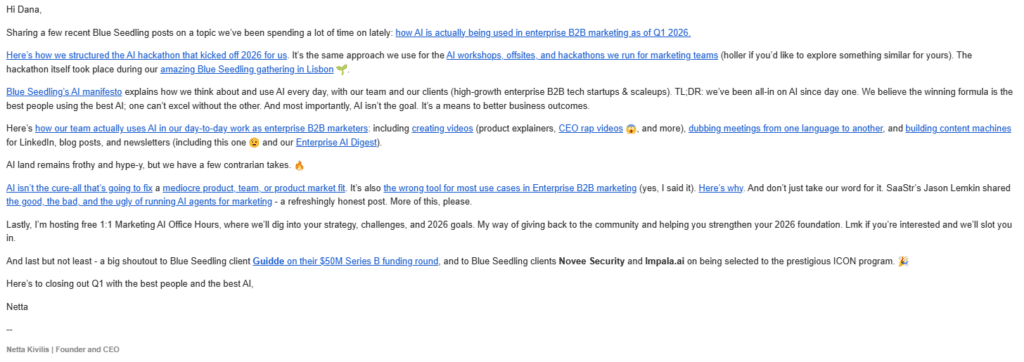
…Yep, just like a regular, personal email.
We have replicated this type of newsletter with startups of different sizes, stages, and verticals. And from fintech to biotech to ecommerce, we’ve seen audiences become not just readers, but fans…and then eventually, prospects and clients. Here are some real responses we’ve received:

At one startup, a weekly Reader resulted in about 2 new Sales Opportunities per month, and at another startup, a twice-monthly Reader regularly garnered more opens, clicks, and responses than any other type of marketing email. One founder (who built a Reader-style newsletter program by himself) got 2 Sales Leads directly from the newsletter and saw a 40% increase in email subscribers…all in the first months of the program.
Here’s our guide to building your own Reader – our recommended B2B email newsletter format
How to Write It
- Write like a human. As we’ve written before, language that sounds too much like a sales pitch is a major turn-off for most audiences. Leave the jargon and clickbait behind, and write your Reader like you are writing to a colleague or friend. Striking this tone can be easier said than done. AI can help you draft and refine your email, but it shouldn’t replace your voice; the goal is still to sound like a real person.
- Become a curator, not just a marketer. A good Reader directs the audience to thoughtful material that is relevant to them—industry news, interesting case studies, etc. As a founder, you should know your audience better than anyone, and you’ll know what kind of content they are looking for. If you already have top-notch original content, you should share it, too, of course. AI can also help you discover and summarize content faster, but your perspective is what makes it valuable. What makes the Reader an especially high ROI type of email is that there is no high-effort content required. You only need to choose some thoughtful, high-impact articles from your industry, add your unique (and brief) insights, and send.
- 4 parts content, 1 part sales. Even though the Reader should be mostly links to articles and valuable insights, there’s nothing wrong with including a short note about your startup. We just recommend a 4:1 proportion of content to anything sales-y, like in this real example we made for a client:

How to Build It
- Use your preferred email marketing software (Mailchimp, etc.), and choose the simplest format available (e.g. Text only, no HTML). The most “designing” you should do is inserting links or lightly formatting your signature. Even if you’re using AI tools behind the scenes, the final output should still feel like a one-to-one email.
- Have the Reader come from a real person—not marketing@your-startup.com, for example. We’ve found that this increases both the personal feeling of the email and the likelihood of replies. Make sure the Reply-to address matches the From address, and the display name is the person’s full name, as well. For example:
From: Netta Kivilis (nkivilis@blueseedling.com)
Reply-to: nkivilis@blueseedling.com - Keep the subject line simple and conversational. Be enticing enough to elicit an Open, but not overly clickbaity. Finding this balance can be tricky, but it gets easier over time as you get to know your audience.
Why The Reader Works (Especially for early-stage startups)
- Creating a Reader is a relatively fast process — and even if you’re a team of one, it’s easy to DIY. No images or extra HTML means no need for a designer. As a founder or early start-up employee, finding valuable industry content is something you should be doing anyway. Especially now, when inboxes are filled with automated and AI-generated emails, something that feels truly personal and provides real value cuts through.
- The Reader gives you a way to initiate “personal” conversations with your audience. Every newsletter is technically an email from a real person, but the Reader actually looks like one. Your audience will be more likely to interact and respond, perceiving that there is a real person on the other end.
Speaking of real people — if you’re still not sold on this type of campaign, check out the story of one technical founder’s success with this type of email marketing. El-ad David Amir, CEO and founder of Astrolabe Diagnostics, built a Reader-style email program by himself, and 28 issues later, he’s still seeing results.
The Bottom Line
Email newsletters can be an effective means of reaching your audience, but common newsletter formats make more room for design elements and brand identity than valuable content. For most early-stage startups, the Reader—a simple, mostly plain-text email from a real person—is the perfect vessel to share relevant content with your audience and to begin to build a relationship with them.
Nearly 10 years into building Blue Seedling, this is still one of the simplest and most effective ways we’ve seen to turn an audience into real conversations, especially in a world full of AI-generated noise.